
This content is also available in Portuguese (PDF)
Key Points
- The lack of information, transparency and consistency about oil accidents across the American continent constitutes a dangerous pattern.
- Despite this, the available data analysis shows that accidents are frequent and can occur at different stages of the oil chain.
- Of 35 countries, only three present regularly updated, open datasets on oil accidents: the continent’s three major oil producers and consumers, Brazil, Canada and the United States.
- Even where some data on oil accidents exist, they are characterised by gaps and inconsistencies. Public databases often omit crucial measures, such as the extent or type of ecological or property damage, or loss of human life.
- The number of accidents and volume of oil spilled are the only two datapoints collected in all three countries’ available datasets. Brazil alone names the company responsible for a spill in its dataset, with Canada doing so only in its reporting of pipeline accidents. Brazil has the most complete oil incident dataset on the continent, registering an average of 5.5 incidents per day, including accidents and “almost accidents”. But the data contains inconsistencies and gaps that make impact assessment difficult.
- The Amazon, a rich socio- and biodiversity hotspot with logistical challenges, is a particularly sensitive environment to oil accidents to the infrastructure necessary for sourcing, refining, exploitation, and transportation of oil.
Oil accidents in the Americas
The Americas play a central role in the global petroleum system. The region is home to three of the world’s 10 largest oil producers and consumers – the United States, Canada, and Brazil – representing a substantial share of global extraction, refining and trade.
The continent has experienced a series of accidents associated with oil exploration, production, transportation and other stages of the supply chain. The oil spill in Ixtoc (Mexico) in 1979, the sinking of the Ocean Ranger (Canada) in 1982, the Enchova (Brazil) episode in 1984, the Exxon Valdez spill (Alaska’s Prince William Sound) in 1989, the Deepwater Horizon spill (United States) in 2010 and the 2019 oil spill from a tanker off the northeast coast of Brazil, which affected hundreds of locations in at least nine states, are among the most well-known incidents across the Americas in the last decades.
Current proposals to expand oil exploration and production across the Americas highlight the importance of understanding the potential impacts of any incidents or accidents. However, as this briefing shows, the basic information needed to assess risk is lacking in many American countries, and even where it exists, it is characterised by inconsistencies and a lack of transparency.
The interconnections and cross-border impacts of oil accidents
The negative consequences of oil accidents in the Americas transcend national borders, affecting shared ecosystems such as the Gulf of Mexico, the Amazon Basin and the Caribbean Sea, home to the world’s second-largest barrier reef. Oil spills, pipeline ruptures and offshore leaks often generate cross-border contamination and regional socio-economic repercussions.
The continent’s petroleum supply chain is structurally interconnected, with crude oil, refined products and petrochemical derivatives circulating through an extensive infrastructure network of pipelines, refineries and maritime routes. These physical and economic links include the Keystone Pipeline, which brings Canadian crude oil to refineries in the United States and has suffered a series of ruptures; the Trans-Panama Pipeline, which crosses Central America to connect Panama’s Caribbean and Pacific coasts; and the Trans-Andean Pipeline, which after being decommissioned for almost two decades has been re-established as a route to supply Argentinian oil to Chile.
These cross-border connections make a continental analysis of accidents and their impacts not only relevant but also necessary for understanding the systemic vulnerabilities of the oil supply chain and promoting coordinated environmental governance.As governments seek to expand oil operations, from the Trump administration’s desire to “drill, baby, drill” and Canada’s aim to become an “energy superpower”, to proposals to build new shipping facilities in the San Matías Gulf in Argentina and the recent licensing of drilling in the Brazilian Amazon, it is increasingly important to understand the real impacts and dangers of the oil industry within the continent.
There is a lack of transparency about oil accidents on the continent
Almost half of the 35 nations in the Americas are oil producers, but only three have open datasets on oil accidents with periodic updates.
Brazil, Canada and the United States, the three major oil producers and consumers on the continent, regularly publish open data about oil accidents. However, only Brazil provides broad coverage of industrial accidents in a single dataset, while data from the US and Canada is more limited in scope and presents more scattered information, as both countries divide the data between oil spills and pipeline accidents.
Other countries present annual or periodic reports/information with varying levels of detail and using different types of registers; for example, Mexico provides data on the total number of accidents and volume of oil spilled annually (see Box 1), while Peru has, on at least one occasion, released ad hoc communication in response to accidents.
Box 1. Case study: Mexico’s official records do not reflect the totality of accidents
Mexico records oil spills and leaks at various stages of the production chain, primarily in pipelines, maritime terminals, offshore platforms, and refining and transportation infrastructure.
Since 1999, Mexico’s Department of Environment and Natural Resources (SEMARNAT) has provided official data on accidents at each stage of the country’s state-owned oil operations. Each year, SEMARNAT reports the number of accidents, the volume spilled, and the Pemex1 subsidiary responsible.
Despite those records showing 10,600 oil accidents between 1999 and 2020, several independent analyses indicate significant underreporting. A recent investigation into the Gulf of Mexico by Data Crítica and Mongabay Latam found that an estimated 60% of oil spills captured in satellite imagery from January 2018 to July 2024 were not reported by the companies responsible.
Between 2018 and 2021, state-owned oil company Pemex documented 176 spills and leaks of moderate to high environmental impact, affecting soil, rivers and seas, especially in the states of Tabasco and Veracruz, which were affected by approximately 63% of these incidents. However, these events do not include minor incidents documented in the company’s sustainability reports, which media reported as totalling 2,935 events from 2018 to 2020. This larger figure aligns more closely with the SEMARNAT data, which reports 2,019 Pemex oil accidents for the period, with no reference to severity.
Even where some information on oil accidents exists, the datasets are characterised by gaps and inconsistencies. Public databases often omit crucial measures, such as the extent or type of ecological and property damage or impact on human health and wellbeing. Incidents are described in various ways, with little clarity on what constitutes an “accident” and no consistency from country to country in terms of the thresholds used to describe the severity of incidents.
This lack of consistent and transparent data, violates international norms such as the UN Guiding Principles for Business and Human Rights and the OECD Guidelines for Multinational Enterprises. It creates challenges around accountability and hampers comparative analysis and effective response planning.
There are some global data sources which track accidents from selected nodes in the oil production chain, providing a model for greater transparency. ITOPF, a non-profit working to promote effective responses to marine oil spills, has recorded tanker oil spills globally since the 1970s. It uses this data to track trends on the scale of spills and the causes of accidents against data on seaborne oil trade, as well as to publish annual data at a more granular level.
The best public data sources in the Americas don’t provide basic information on oil accidents
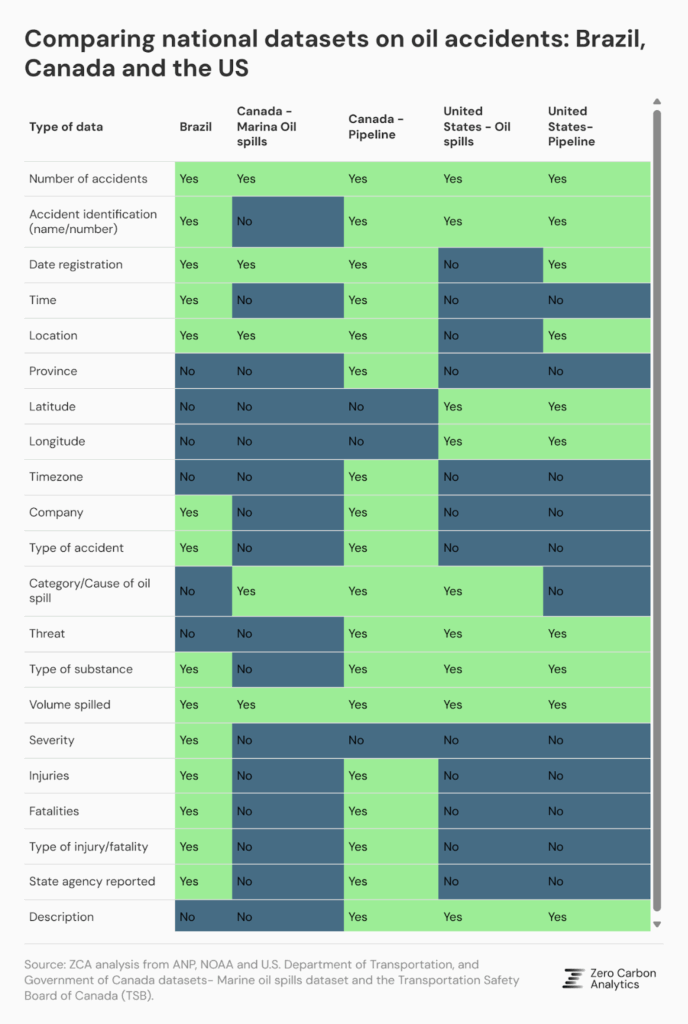
A detailed comparison of the records compiled by the region’s three largest oil producers shows the extent of the inconsistencies and data gaps.
Brazil, Canada and the United States’ open datasets on oil incidents represent the best publicly available data in the Americas, yet they do not provide details on many fundamental aspects of these events, making it difficult to identify the causes or the impacts. The number of episodes and the volume of oil spilled are the only two categories presented across these datasets. Another key piece of information, the company responsible for the incident, is only available in the Brazilian dataset and the Canadian database on pipeline accidents (which does not cover oil spills).
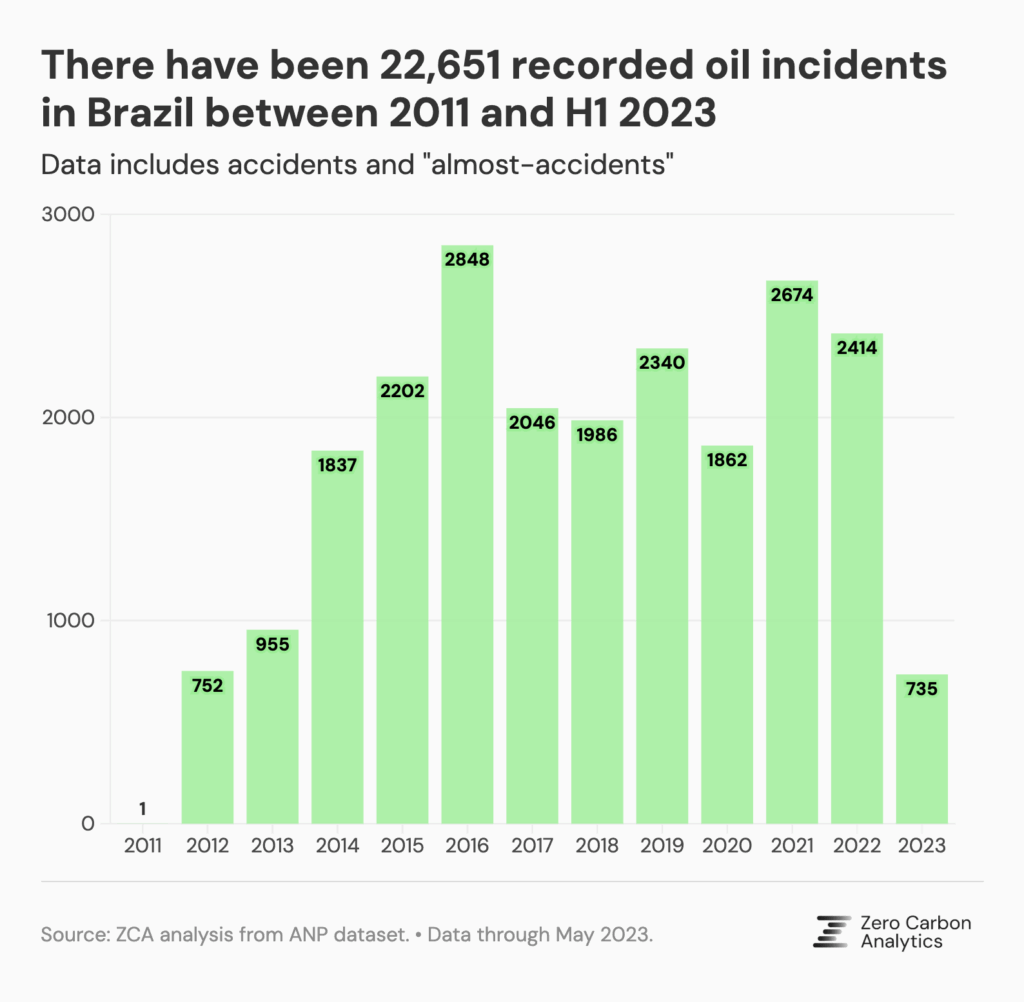
In Brazil, the total number of government-reported oil incidents between 2012 and 2023 was 22,261,2 representing an average of 2,024 per year or 5.5 per day. Officially, Canada had 3,097 oil spills between 2010 and 2024, and 3,370 pipeline accidents since 1979. In the United States, 4,797 oil spills have been reported since 1957, as well as 12,671 pipeline accidents.
Available data: the United States
In the US, the National Oceanic and Atmospheric Administration (NOAA) takes responsibility for gathering and sharing raw incident data via its ‘IncidentNews’ site. This includes categories of incidents for which they provided scientific support, as well as older spill records from other databases.
The Department of Transportation provides information on the country’s pipeline accidents via the Pipeline and Hazardous Materials Safety Administration (PHMSA). The PHMSA dataset covers the last 20 years and includes the number of reported accidents, fatalities, injuries, costs and causes.
Finally, the National Response Center publishes an annual database of initial incident data on all types of accidents, including those related to oil. However, this information has not been validated or investigated by a federal or state agency.
Available data: Canada
Canada’s National Aerial Surveillance Program (NASP) and National Environmental Emergencies Centre (NEEC) have maintained a dataset on marine oil spills since 2010, based on aerial surveillance and reports from the public. The dataset, which is not comprehensive, is unable to record the size of around half of reported spills.3
The Transportation Safety Board of Canada (TSB) records pipeline transportation occurrences regulated by the federal government. It presents information on episodes, fatalities and injuries, installations, accidents and products released.
Available data: Brazil
The Brazilian National Agency of Petroleum, Natural Gas and Biofuels (ANP) gathers data to maintain its incident reporting system for exploration and production accidents. The ANP classifies oil accidents by the severity of damage, location and other relevant factors, including the company responsible.
Table 1 (below) provides a high-level analysis of the information presented by the three nations’ datasets. It shows that in addition to the differences in overall coverage, there are also striking omissions in basic information on fatalities and the severity of accidents, particularly in the US and Canada.
Table 1.
Brazil’s accident registry is the most complete in the Americas, but presents inconsistencies
The ANP4 provides the most detailed information on oil accidents in the Americas, including reports published about specific episodes. The ANP has reported 22,651 incidents since 2011 (see Figure 1), including both ‘almost-accidents’ and accidents. However, inconsistencies and important gaps within the official dataset continue to make meaningful assessment of the episodes difficult.
Fig. 1
A key inconsistency in the ANP reporting is the incident date, which is unknown in more than 10% of cases. Of the incidents that have a recorded date, this sometimes does not tally with when the accident (or near miss) was first observed or reported. This inaccuracy could pose challenges for people and communities who experienced harmful effects from oil spills before they were officially logged.
One critical data gap involves the type of incident, which would support an assessment of severity. Almost 10% of ANP records are labelled “reclassification”, providing no detail on the nature of the oil accident. The ANP data also lacks a measure of severity in relation to the volume of substance spilled: this is recorded, but without a unit of measurement.
Lack of clarity is also a challenge. ANP reporting applies a classification system for the impact of incidents, which include damage to the environment, property and human health, and “risk to” the environment and human health. Incidents can have multiple classifications, depending on the scope of the event. However, there is no definition of what distinguishes actual harm from risk of harm, or the timeframe over which these are measured, although many risks may only become harms after the passage of time. At present, around 78% of risks posed by recorded oil incidents in Brazil are classified as posing a risk to environmental or human health (see Figure 2).
Fig. 2

Lack of data makes it hard to assess risks of future drilling
The lack of clarity around the impact of oil accidents in Brazil is problematic for many more reasons. From a forward-facing perspective, the absence of comprehensive historical data impedes an effective risk assessment process for future decisions on industry developments.
This topic is particularly important given that drilling is being expanded in sensitive – and ecologically important – regions like the Amazon. Around 60% of the Amazon Forest is in Brazilian territory. But the uncertainties and risks around oil search and exploitation in the area are not exclusive to the Brazilian frontiers (see Box 2).
Box 2. Oil infrastructure in the Amazon exposes a sensitive environment to risks
The Amazon has been the scene of numerous oil accidents of various types in recent decades. As is true across the Americas, a lack of information regarding these incidents, given the absence of a regional dataset, means that it is impossible to quantify the impact of and risks posed by the oil industry in the region.
Independent organisations and state agencies have been working to record oil accidents and examine infrastructure problems in local contexts, providing some evidence that points to the scale of the sector’s impact on the region.
In the Peruvian Amazon, approximately 474 oil spills were recorded between 2000 and 2019, primarily due to operational failures and infrastructure corrosion, both in oil fields and the onshore pipeline that runs through the forest.
Ecuador also faces structural issues related to the oil supply chain. The Trans-Ecuadorian Pipeline System (SOTE), which runs mostly through the Amazon, recorded 65 incidents between 1972 and 2019, resulting in approximately 730,000 barrels of oil spilled. Most of these events were caused by landslides and riverbank erosion, although the pipeline also sustained significant damage on two occasions due to earthquakes.
In other cases, oil spills have contaminated areas in an extremely sensitive environment. A 2023 investigation identified more than 8,000 contaminated or potentially contaminated sites in four countries (Bolivia, Colombia, Ecuador and Peru), including abandoned wells, soils containing crude oil residues and oil spills.
Ageing infrastructure and pipelines built decades ago, often on exposed terrain, are identified as structural risk factors in these regions.
In Ecuador, ruptures in old oil pipelines, such as the SOTE, have caused significant spills, contaminating rivers and protected areas, and threatening Indigenous communities. A 2022 incident in the Cayambe-Coca Park is an example: after a landslide caused by rain, a pipeline ruptured, spilling approximately 6,300 barrels of oil, affecting a sustainable forest corridor, rivers and protected areas.
In short, the exploration, production, refining, and transportation of oil require infrastructure that can often harm the environment, including around closed and abandoned fields.
