
This information is up to date as of 16:00 Turkey time, 19 November 2026
Key points
- 90 governments have expressed support for the “35-by-35” Global Electrification Pledge, as of 19 November. The target aims to grow electricity’s share of the world’s final energy demand to 35% by 2035.
- During COP31, at least 15 countries have made clean energy and electrification pledges. Host nation Turkey has signed two key bilateral agreements, securing an investment of up to USD 15 billion from China for 7 GW of domestic wind and solar, and a USD 4-5 billion framework with Saudi Arabia for 5 GW of renewables. Brazil put forward a 10-year roadmap to help more countries transition away from fossil fuels.
- Electrification progress since COP30 has gained global momentum. China set a goal to reach 35% electrification by 2030 as part of its new Five-Year Energy Plan, and the UK and Ireland have published electrification roadmaps.
- Transport and industrial sectors are also catching up. Global electric car sales have jumped from 25% in 2025 to an estimated 29% in 2026, and electricity is competitive with fossil fuels for 40% of industrial heat.
- Since the start of the 2026 Hormuz energy crisis, marking the second energy crisis in five years, 25 countries (plus the European Commission) have implemented new electrification policies. Half of these were in Asia-Pacific – the region most exposed to the impacts of the crisis – followed by a strong showing in Europe.
- The 2026 IEA World Energy Outlook, launched on 19 November, highlights that the crisis “has reinforced the strategic case for electrification”. If governments turn their post-crisis signals into policy, fossil fuel-importing regions will reach 38% electrification by 2035.
This briefing focuses on the acceleration of global momentum for electrification in 2026, which was spurred by the second global fossil fuel crisis in five years (Figure 1) and the growing economic advantages of clean technologies.
According to the IEA, significantly speeding up electrification in fuel-importing countries could cut energy import bills by more than USD 400 billion by 2035, compared with 2025 levels. Household energy costs could be slashed by 15%.
Governments are realising the benefits. Since the start of the Hormuz crisis in March 2026, 25 countries (plus the European Commission) have implemented new electrification policies (Figure 2).1Last updated 21 Oct 2026. Half of these were in Asia-Pacific – the region most exposed to the impacts of the crisis.
In the lead-up to COP31, as well as on conference sidelines, countries have made further commitments to accelerate the clean electrification shift.
Figure 1
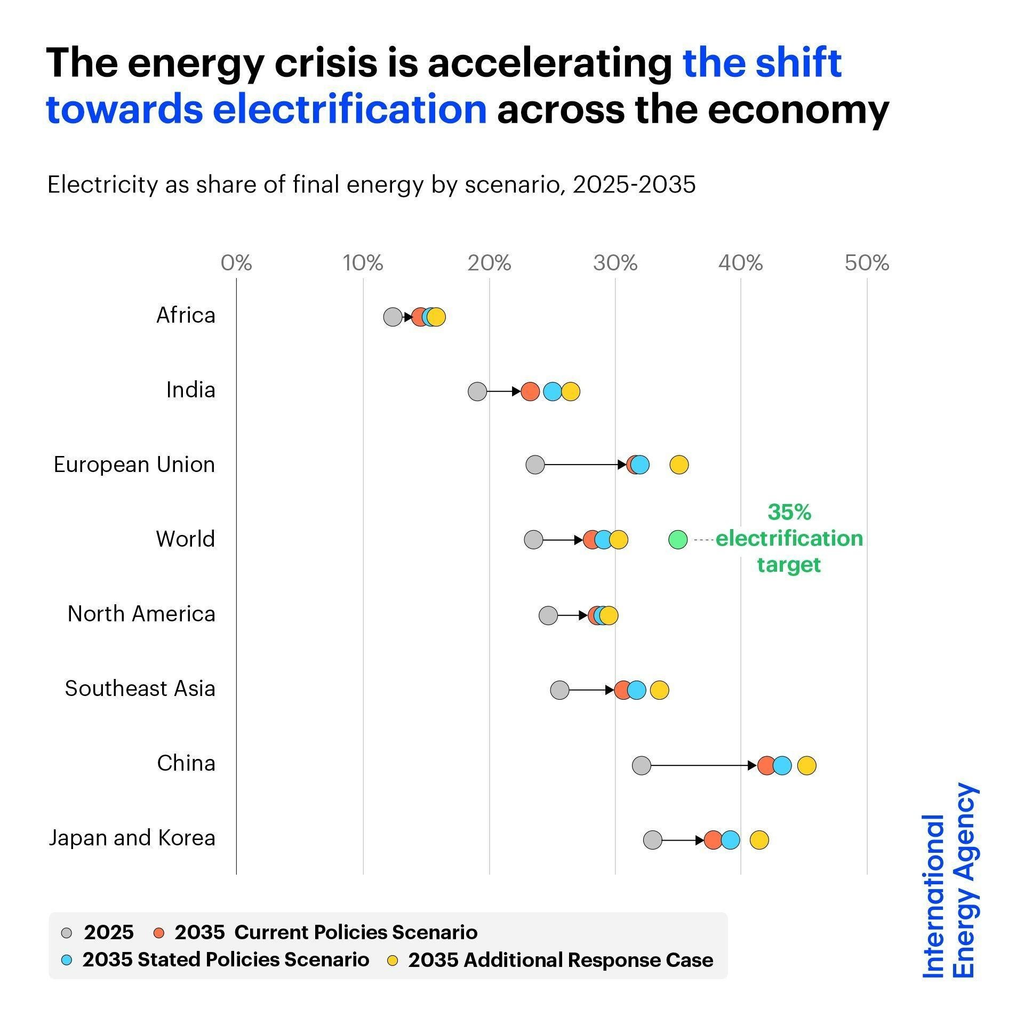
Source: IEA (2026), World Energy Outlook 2026, IEA, Paris
https://www.iea.org/reports/world-energy-outlook-2026, Licence: CC BY 4.0 (report); CC BY NC SA 4.0 (Annex A)
Figure 2
Agreements on clean electrification around COP31
- 90 governments are reported to have expressed support for the “35-by-35” Global Electrification Pledge, as of 19 November.2This figure is set to change as more countries join the pledge during the conference.
- Brazil has put forward a roadmap to help countries plan their transition away from fossil fuels over the next decade. France, Germany and the Netherlands published national roadmaps before COP31. Other countries, including Finland, Denmark and Portugal, announced theirs at the conference.
- Turkey and China signed a Memorandum of Understanding (MoU) for China to invest up to USD 15 billion in 7 GW of solar and wind generation in Turkey, along with electricity storage and 4 GW of electricity transmission infrastructure.
- A group of countries launched the Antalya Green Industrialization Compact, aimed at electrifying industry and creating markets for low-carbon industrial products.
- Saudi Arabia and Turkey have agreed to a USD 4–5 billion framework to deploy
5 GW of renewable energy capacity in Turkey, including 3,000 MW of wind power, battery storage, and HVDC transmission infrastructure. - Denmark and Australia signed an agreement to expand trade in renewable energy and green technologies.
- Australia and Indonesia signed an MoU to strengthen support for Indonesia’s energy transition and the development of its electricity sector.
- Azerbaijan, Bulgaria, Georgia and Turkey signed an intergovernmental agreement to develop a clean energy corridor.
Electrification progress since COP30
National governments are setting goals and taking action
- China set a goal to reach 35% electrification by 2030 as part of its new Five-Year Energy Plan, announced in June 2026.
- Germany’s governing coalition is working on an agreement to lower the electricity tax rate, making electrification more affordable.
- The UK published a national electrification roadmap, signalling its commitment to reaching the 35% electrification goal by 2035.
- Ireland also published Phase 1 of its Electrification Roadmap in November.
- The EU published an Electrification Action Plan with an indicative target of 46% electricity in final energy by 2040, against 23% today.
- Denmark has allocated DKK 267.5 million (USD 41.5 million) to extend its residential heat pump subsidy scheme through 2027, alongside additional funding for gas network disconnections. The agreement also outlines plans to ban new oil and gas boiler installations from 2028. The country also has plans to help lower-income households move to electric cars.
Agreements are strengthening finance, collaboration and interconnections
- India and South Korea issued a statement on cooperation in climate and sustainability in April, including renewable energy. (In a recent notable milestone, clean energy met more than half of India’s electricity demand for the first time.)
- In the same month, Ireland and the UK renewed their agreement to cooperate on energy, including offshore renewables, electricity market integration and supply security as the countries scale offshore wind.
- Ireland also worked with Spain to launch a framework to assess electricity interconnection between the countries, which would support sharing of renewable energy and supply stability.
- Southeast Asian nations signed an enhanced MoU to strengthen the framework for a regional, integrated power grid at this year’s ASEAN summit.
- In February 2026, the UK and the State of California signed an MOU on climate, clean energy and environmental cooperation.
Electrification in transport is accelerating
- Electric car sales are expected to reach 29% of total car sales worldwide in 2026, up from 25% in 2025 and just 4% in 2020.
- A record 65% of cars sold in mainland China in August were either pure-electric or plug-in-hybrid models. In China, EVs now displace 1.3 million barrels of oil a day.
- In the EU, battery-electric vehicles outsold petrol cars for the first time in the third quarter of 2026.
- In Southeast Asia, the share of electric cars jumped to around 30% of all car sales in the first half of 2026, up from 18% in 2025.
- Over 150,000 medium- and heavy-duty electric trucks were sold globally in the first half of 2026, a 75% jump from the same period a year before.
- The world’s largest battery-powered ferry began commercial service in October 2026.
Industrial electrification is gaining ground
- In 2025, electricity was already economically competitive with fossil fuels for around 40% of low- and medium-temperature industrial heat.
- Traditionally polluting industries are showing interest: in Australia, mining group Rio Tinto is assessing whether it can use a massive thermal battery to replace fossil fuels in alumina refining. In the same country, Fortescue has taken the first steps towards introducing battery-electric mining trucks as the group seeks to eliminate operational emissions at its Pilbara site.
- The H&M Group worked with Shanghai-based supplier JQR in 2025, installing an industrial heat pump and thermal storage system to reduce reliance on natural gas. The company reports lowering its natural gas consumption by 75% and energy costs by 45%.
What the IEA’s latest World Energy Outlook report says
- The report, published on 19 November, says the crisis “has reinforced the strategic case for electrification”, with 25 countries (plus the European Commission) having announced new electrification policies since February.
- If governments turn their post-crisis signals into policy (the Additional Response Case, or ARC, scenario), importing regions reach 38% electrification by 2035, or two percentage points above the STEPS scenario.
- High oil prices have made EVs more competitive. About 28% of global car sales are estimated to be electric in 2026, and electric freight truck sales rose nearly 75% in the first half of the year.
- Many fossil fuel-importing countries, notably in Africa and Asia, saw sharp rises in imports of batteries, electric cars and solar panels from China in 2026.

