
Key points:
- Raising livestock to produce animal products for consumption, such as meat, dairy and eggs, is responsible for 12.5% of the world’s total annual greenhouse gas (GHG) emissions.
- These emissions contribute to climate change, the impacts of which are ultimately borne by the public, including worsening heatwaves, droughts, extreme weather events, and sea-level rise.
- Assigning a monetary value to emissions from high-emitting industries is a well-established method of estimating the financial burden that they place on society.
- Using carbon prices derived from climate mitigation pathways, a new analysis by ZCA estimates that the emissions caused by producing animal food products create a global financial burden of up to USD 2.1 trillion per year – a cost that falls on society, not the livestock industry.
- More than two-thirds of the global price tag of livestock emissions arises from the production of meat, primarily the raising of cattle.
- 39% of the global financial burden of livestock emissions can be attributed to production in Brazil, China and India.
- However, with approximately USD 299 billion worth of livestock products for consumption exported globally every year, accountability for emissions and their costs to society travels along supply chains to importers and consumers worldwide.
- Livestock emissions – and their costs – can be reduced through government policies that encourage healthy dietary change and lower the demand for animal products. Wealthier nations with meat-heavy diets are well-positioned to take a lead on this.
The growing burden of livestock production
Raising livestock for food, including meat, dairy and eggs, resulted in an estimated 6.7 billion tonnes of CO2 equivalent (CO2eq) emissions in 2022,1 accounting for 12.5% of the 53.8 billion tonnes of CO2eq emissions released globally that year. Livestock is also the largest single source of emissions within the agri-food sector.
Livestock emissions have been rising: between 2000 and 2022, they increased by 19%, driven by a 21% growth in per capita global meat consumption.
Higher emissions translate into real-world economic losses for society, including more instances of extreme heat, droughts and floods that destroy crops and raise food prices; rising healthcare costs from heat-related illness; and the loss of infrastructure and property to extreme climate events.
Currently, the financial burden caused by livestock emissions is dispersed across society as a whole, shouldered by households, businesses, taxpayers and governments, rather than being borne directly by livestock producers, or any part of the supply chain that responds to consumer demand.
As the cost is not accurately reflected in the process of producing animal products, it does not impact the price of meat, dairy or eggs. And with the financial toll of emissions seemingly invisible, there is currently very little incentive to reduce them.
Putting a price on livestock emissions
Carbon pricing offers one way to quantify the monetary impacts of emissions from livestock – a sector that has escaped much GHG-related public scrutiny to date. This approach can be used to estimate the uncaptured costs (or externalities) that represent the cost society pays for GHG emissions.
Carbon prices vary depending on the mechanism used, such as carbon taxes, emissions trading schemes, or estimates of the social cost of carbon, and on their intended purpose, for instance, generating revenue or driving emission reductions.
In this analysis, we use carbon pricing scenarios to quantify the cost of livestock emissions by assigning a monetary value per tonne of CO2eq. Here, carbon pricing is used as a theoretical tool to estimate the financial burden of GHG emissions,2 and does not indicate how a carbon pricing mechanism would be implemented in practice.
To date, livestock emissions have rarely been incorporated into carbon pricing mechanisms,3 with the recent exception of the Danish government’s agricultural carbon tax, announced in 2024. This lack of inclusion is due to complexities in implementation, as well as political and social resistance.
The limitations of carbon pricing
It is important to note that this approach captures only the climate-related externalities, not the full range of environmental and social impacts driven by livestock production, such as biodiversity loss from land conversion, antimicrobial resistance from veterinary drug use, or the healthcare costs of excessive meat consumption.
To give a sense of what is excluded, a 2015 study estimated that every tonne of beef produced generates USD 5,108 in natural capital costs from air, water and soil pollution; water consumption; land use change; and land clearing (in addition to the USD 3,312 in costs from GHG emissions). Any claimed land use benefits from livestock production, such as carbon sequestration in soil, are negligible in comparison.
The health-related costs of consuming animal products pose an additional financial burden to society. In 2020, the health-related costs of consuming red and processed meat were estimated at USD 285 billion globally.
Applying a monetary value solely to GHG emissions is consistent with the approach taken across various industries that use carbon pricing schemes and mechanisms – only GHG emissions inform the estimated cost.
Applying existing carbon pricing to livestock emissions
Research has begun to quantify the financial burden imposed on society by livestock emissions, with one study estimating that diets high in animal protein impose approximately USD 72 per person per year in additional climate damages. A European analysis of the external climate costs of food ranked animal-based products highest, at EUR 2.41 per kilogram.
A 2017 study estimated the social cost of India’s livestock-based methane emissions at between USD 62 and USD 1,150 per tonne of methane – and predicted this figure would continue to rise. However, we are still missing a comprehensive global estimate of the financial burden caused by the full range of livestock emissions.
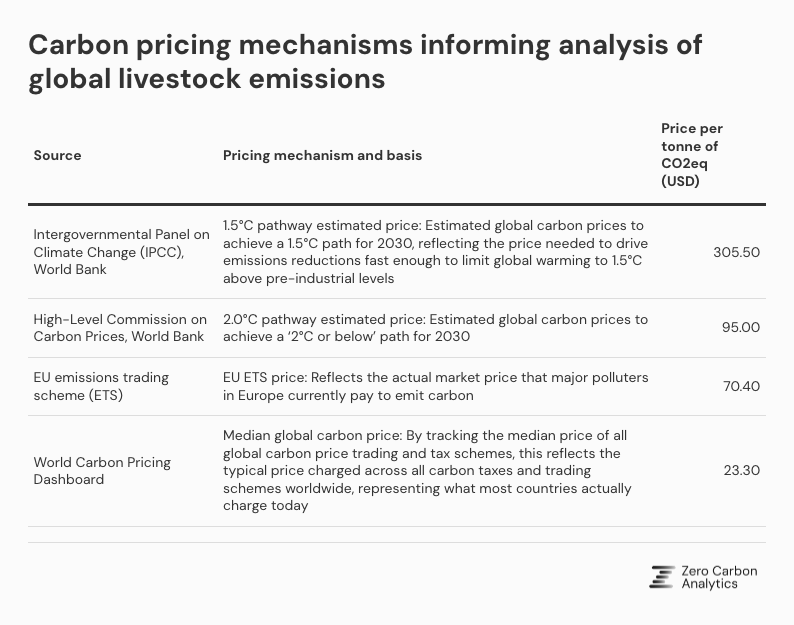
To estimate the global financial burden of livestock emissions, we used the latest available data from the UN Food and Agriculture Organization (FAO)4 and assigned a financial value to emissions using four different carbon pricing mechanisms.
The mechanisms chosen, detailed in Table 1, reflect a range of scenarios, from meeting Paris-aligned climate targets down to current policy reality.5 They are, in brief:
- A price consistent with limiting global warming to 1.5° by 20306
- A price consistent with limiting global warming to 2° by 20307
- The actual price major carbon emitters currently pay in Europe8
- A median global carbon price reflecting current charges used in countries with carbon taxes or trading schemes.9
Table 1.
What pricing livestock emissions reveals
The global financial burden of livestock emissions is in the trillions
Our analysis suggests that the emissions caused by global livestock production burden society with costs of between USD 0.16 trillion and USD 2.1 trillion every year, depending on the carbon pricing mechanism used (see Figure 1). The upper estimate exceeds the total global climate finance flows of 2023 (USD 1.9 trillion). However, there is likely to be a degree of double-counting in the emissions figure, due to overlap with emissions in the transport and manufacturing sectors.10
Figure 1.
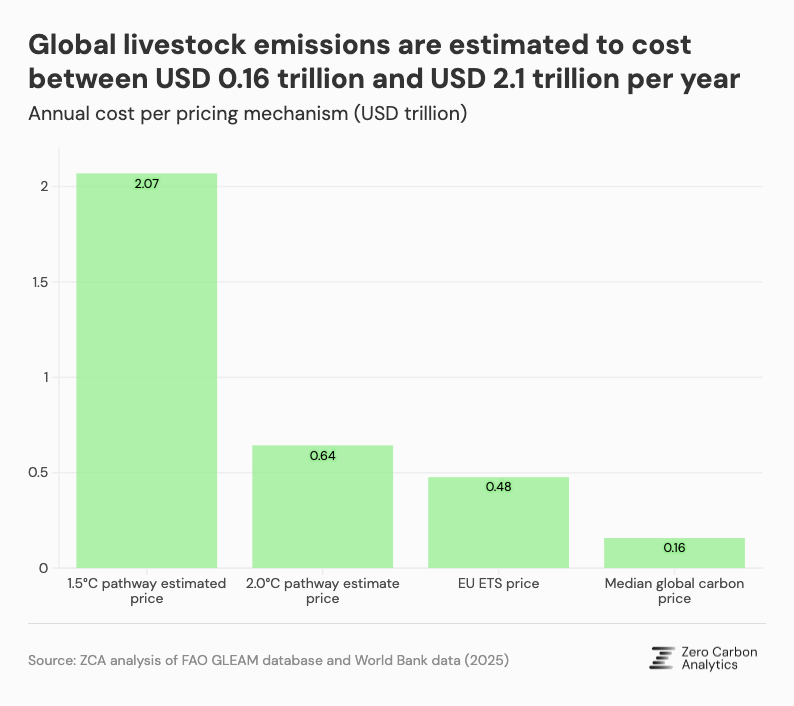
In the following analysis, we consistently apply the 1.5°C pathway-aligned carbon price to estimate the cost of annual emissions in monetary terms, as this reflects continued ambition to meet the targets of the Paris Agreement.
Using the 1.5°C pricing mechanism, it is clear that if dietary trends and livestock production continue unchanged until 2030, the cumulative cost between 2025 and 2030 could exceed USD 10 trillion.
Put another way, the annual financial toll of livestock emissions – a burden which falls on society – could be 1.8 times greater than the value of livestock production, which was estimated by the FAO as USD 1.1 trillion in 2023.11
As noted above, while a carbon price is currently the best available option for estimating the climate-related costs of emissions, it does not capture the costs of the livestock industry’s many other social and environmental impacts, such as pollution and changes to land use.
Meat production is the largest driver of livestock production emissions costs
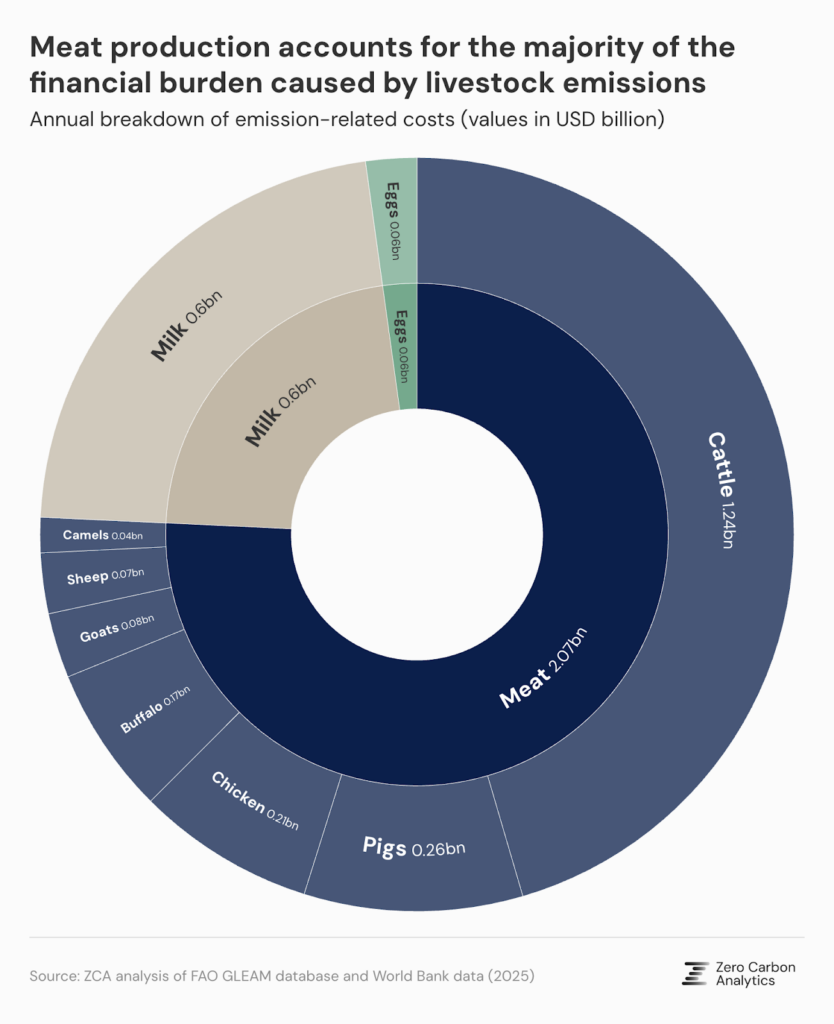
Over two-thirds (68%) of the estimated financial burden arising from livestock emissions can be attributed to the production of meat: as much as USD 1.4 trillion per year. The production of milk and eggs was responsible for 29% and 3% of emission-driven costs, respectively (see Figure 2).
Figure 2.
A handful of countries account for the bulk of the global cost of emissions from livestock production
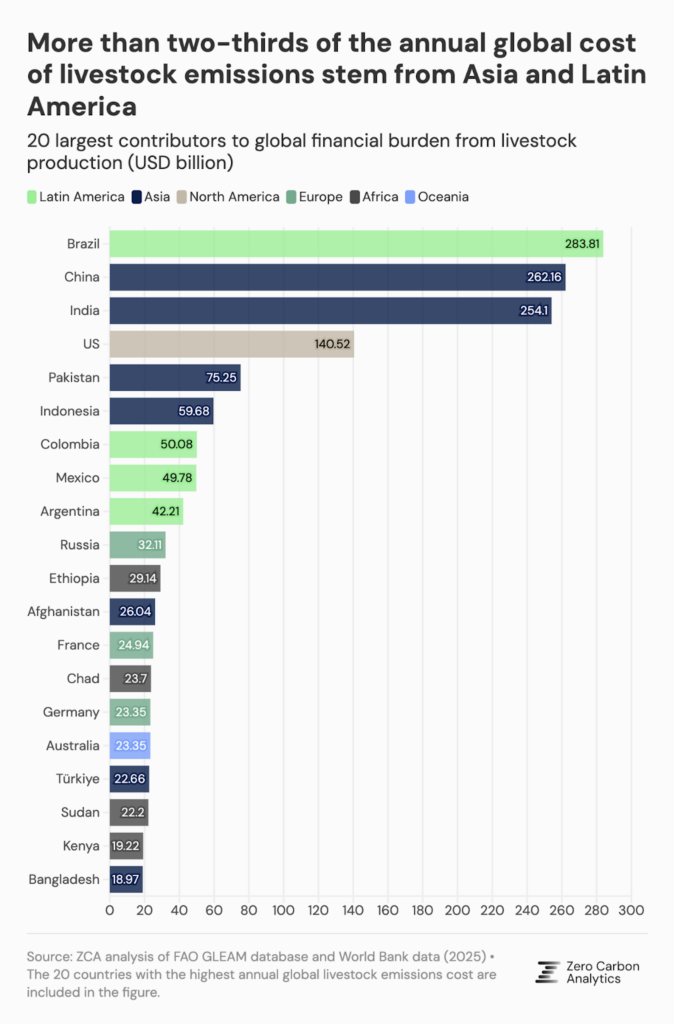
If we break down the global financial burden attributable to emissions from livestock production by region, 43% stems from Asia, 25% from Latin America, 12% from Africa, 10% from Europe, 8% from North America and 2% from Oceania.
By country, the estimated monetary costs of livestock emissions are greatest in Brazil, at USD 284 billion per year (see Figure 3). Together, the three countries with the highest estimated livestock emissions costs – Brazil, China, and India – account for 39% of total global costs.
In India, raising cattle for milk production rather than meat accounts for the majority of livestock emissions, generating 60% of the resulting financial burden.
Figure 3.
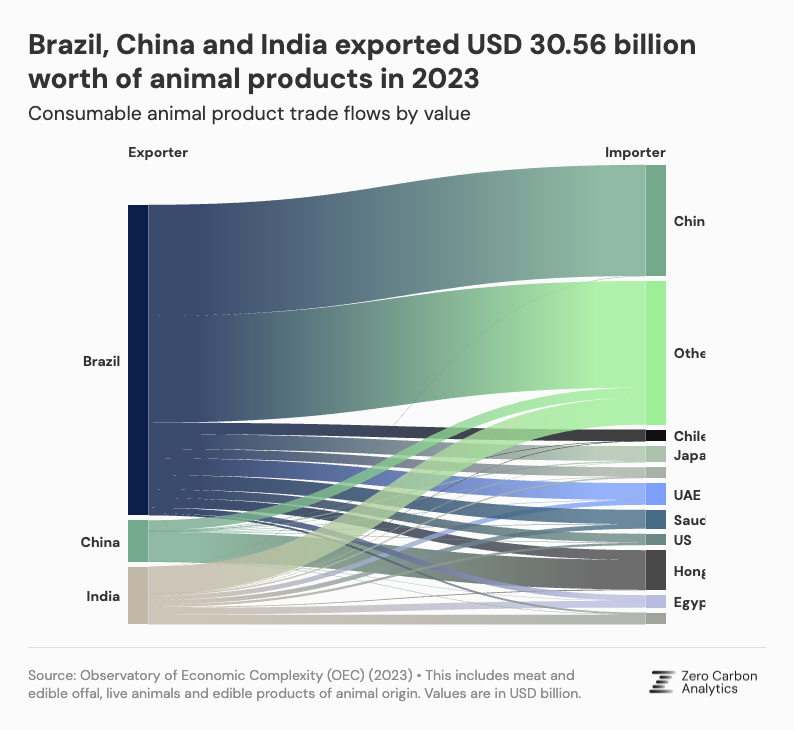
However, viewing the price society pays for livestock emissions through a production lens alone is an incomplete picture. Around USD 299 billion worth of animal products for consumption were exported in 2023, shifting responsibility for emissions along supply chains.12
Together, Brazil, China, and India exported USD 30.56 billion worth of animal products for consumption in 2023 (USD 23.17 billion, USD 3.09 billion, and USD 4.3 billion, respectively; see Figure 4). This means that a substantial proportion of the emissions they generate – and the linked costs – are embodied in exports.
Producer countries carry the physical emissions, but buyers and importing markets drive – and so should be accountable for – a material share of the financial burden.
Figure 4.
Wealthier countries are largely responsible for the costs of consumption-driven livestock emissions
Beyond measuring GHG emissions from the livestock sector at the location where animal products originate, we can also analyse them from a consumption perspective. Attributing emissions to the location where the products are consumed better captures the demand that drives livestock rearing.
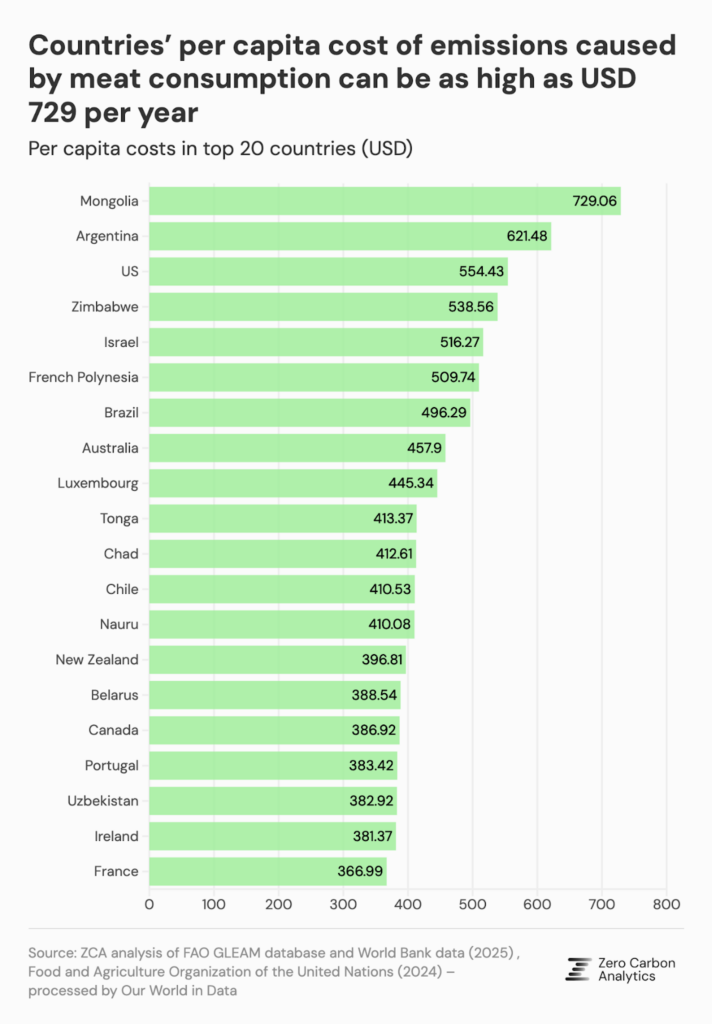
Countries with the highest emissions due to the consumption of meat products per person include Mongolia, Argentina and the United States.13 Applying a carbon price, the financial burden of these emissions runs to hundreds of USD per person every year. In the United States, for example, the per capita annual cost of emissions is USD 554, which translates to a national burden of USD 188 billion (see Figure 5).
The majority of countries with meat-rich diets are classified as higher-income. Of the 20 countries with the highest per capita emissions costs resulting from meat consumption, all but three (Argentina, Chad and Zimbabwe) are high- or upper-middle-income countries.
This highlights that responsibility for emissions stemming from the consumption of meat products is not fairly distributed. In 2025, the EAT-Lancet 2.0 report found that “the diets of the richest 30% of the global population contribute to more than 70% of the environmental pressures from food systems.”
Figure 5.
Consumption-based accounting can support fairer accountability for emissions
Because food is increasingly consumed far from where it is produced, adjusting the accounting of livestock emissions based on how products are traded helps establish more reliable national emissions baselines and effective mitigation strategies.
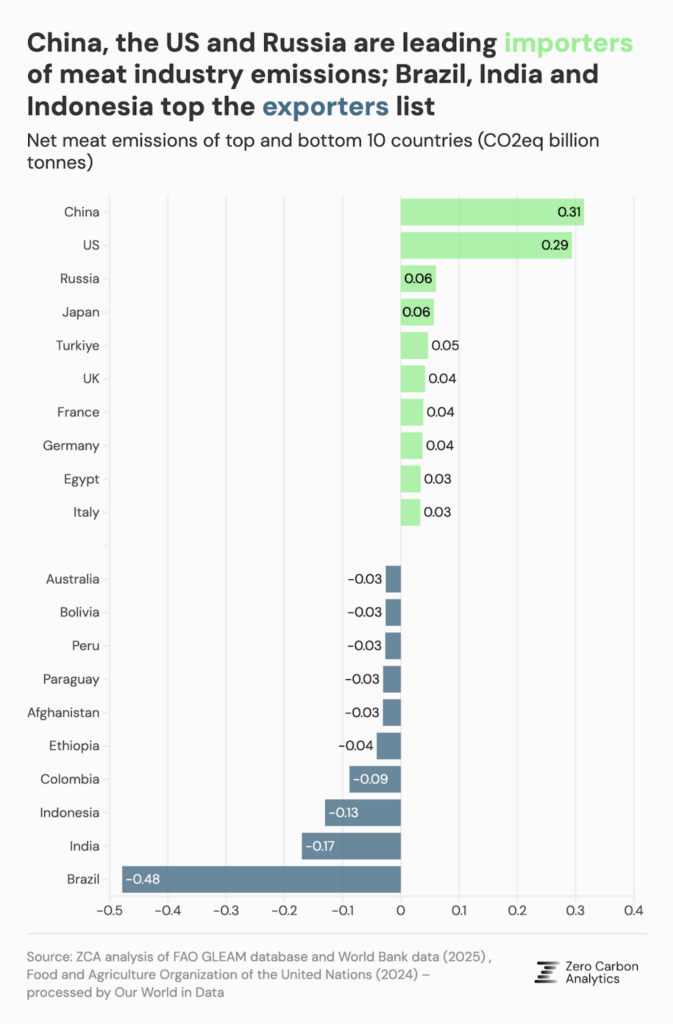
By comparing national emissions resulting from the production and the consumption of meat, we can see that some countries (led by China, the US and Russia) are net importers of embodied emissions in meat products, while others (led by Brazil, India and Indonesia) are net exporters (see Figure 6).
Consumption-based accounting reveals how global trade redistributes climate responsibility. This calls for shared accountability, with importing countries supporting emission-reduction and sustainable-production efforts in exporting regions.
Studies confirm that, across the food system, when a production-based approach to measuring GHG emissions is contrasted with a consumption-based approach, the largest difference is found in countries where ruminant meat, dairy and rice dominate both diets and trade.
Figure 6.
Reducing demand for animal products can cut the cost of livestock emissions
Applying a carbon price to global livestock emissions reveals a significant societal burden: USD 2.1 trillion each year. These costs are borne by people all around the world, especially those living in the most vulnerable countries, rather than by the companies that generate the emissions, which instead reap windfall profits.
A report from UK charity Foodrise estimated that the world’s top 45 meat and dairy companies emitted 1.02 billion tonnes of CO2eq GHG in 2022/202314 – a total exceeding the emissions of most countries, and which would rank as the ninth-highest emitting nation globally. When carbon pricing is applied in line with the 1.5°C pathway, the annual financial burden generated by just these 45 companies is estimated at USD 312 billion.
In the same analysis, the combined emissions of the five highest-emitting meat and dairy companies came to 0.48 billion tonnes of CO2eq – higher than that reported for Shell or BP in 2023. Applying the 1.5°C pathway carbon pricing, these emissions represent a financial burden of USD 137 billion.
Dietary change can significantly cut livestock emissions, reducing climate impacts and costs
Emissions caused by livestock production – and the financial toll they take on society – can be lowered by addressing the growing demand for consumable animal products. Governments and businesses both have a key role to play in reducing demand.
Switching from current consumption patterns to the EAT-Lancet Commission planetary health diet (PHD), which recommends significantly lower intakes of meat for populations that currently overconsume, would cause annual agricultural emissions to fall by 15% in 2050. Using the carbon price aligned with the 1.5°C pathway, this reduction would lower the emissions-based global financial burden by USD 325 billion.15
Another study found that if global food production were geared towards adoption of the PHD diet by 2050 (a 70% reduction in meat consumption globally), 332 gigatons of CO2 could be sequestered by avoiding the carbon costs of animal-sourced food production. This is roughly 99% of the cumulative CO2 emissions budget, which would give a 66% chance of limiting warming to 1.5°C.
Replacing the production and consumption of livestock, particularly ruminants, with a plant-only diet “has the potential” to offset 68% of global CO2 emissions by 2100, according to a 2022 study. This is because ruminants account for 90% of livestock’s climate impact, while providing less than 19% of the protein in human diets.
An additional climate benefit to shifting diets away from animal products and towards plant-based foods is that less land is required for production, and can be used for other purposes, such as restoration. A 2022 paper found that if 54 high-income nations adopted the PHD, and encouraged the spared land to rewild, it could be used to sequester 98 gigatons of CO2eq.
An opportunity for governments to show climate leadership
As well as supporting reduced meat consumption by promoting a shift towards sustainable diets, government policies can help ensure the environmental costs of the livestock industry are accounted for in business operations.
Carbon pricing policy mechanisms are one way to make the climate costs of consumable animal products visible to consumers and producers, and reduce demand.
In June 2024, Denmark announced the world’s first tax on livestock production, with the funds accrued channelled back into addressing climate change. From 2030, a tax rate of EUR 16 per tonne of CO2eq livestock emissions – or almost EUR 100 per cow per year – will be introduced.
Denmark previously experimented with carbon pricing in 2022, when the city of Aarhus introduced a tax of DKK 1,000 (USD 157.5) for every tonne of CO2eq emitted via high-impact products, such as air travel, mobile phones, beef and veal. In its first year, the tax resulted in a 40% decrease in beef consumption and associated emissions.
Companies can apply carbon pricing principles internally to estimate the cost of emissions in their supply chains and inform production decisions. This approach may impact the profitability of livestock production (see Box 1).
Box 1. Emissions pricing could make meat production less profitable
If the livestock industry were responsible for the complete range of its production costs – encompassing the costs incurred by GHG emissions – the profitability of large meat companies could be reduced. The current business model assumes that society will pay the price for the industry’s growing carbon footprint.
While companies in some sectors use emissions pricing to aid mitigation and reduce climate transition risks, this is not standard practice in the livestock industry. If adopted, even small differences in carbon prices may have large impacts.
For example, an assessment of transition scenarios for tropical agriculture notes that the difference between carbon prices for the 4°C (no mitigation) and 3°C (already committed action) scenarios results in 14% higher farm-gate prices (the price of a product before it leaves the farm) for beef by 2050. This increase would likely be transferred to consumers and affect demand for beef products.
Under a Paris-aligned scenario seeking to limit global temperature rise to almost 1.5°C by 2100, emissions costs for large cattle breeders (over 250 head) could rise to match production costs by 2030, and exceed them by up to six times by 2040.
Even carbon pricing as low as USD 53 per tonne of CO2 by 2050 could increase costs by up to 55% of 2021 EBITDA – a measure used to assess a company’s financial performance relative to others in the same industry – for beef companies.16
Adopting responsibility for emissions costs could drive many inefficient producers out of the market as they face competition from lower-carbon beef imports, more sustainable protein alternatives and higher-margin agricultural activities.
For example, the climate transition is expected to significantly impact Colombia’s beef industry, mainly due to its high emissions intensity (from methane) and low profit margins. Changes are expected to result in a substantial reduction in national beef production capacity, posing severe economic challenges for the industry.
Replacing subsidies that support meat production with ones that promote healthy and sustainable diets is another approach that governments can take to reduce demand for meat products, and so cut costly emissions.
A 2022 study found that repurposing agricultural studies to prioritise healthy and sustainable foods would increase fruit and vegetable production, while reducing meat and dairy production and associated GHG emissions. Globally, more than USD 200 billion of public money is spent on direct transfers to subsidise farmers, which can exacerbate the health and environmental issues of food production.
High-income countries that consume significant amounts of meat and import large volumes of animal products can play a leading role in reshaping global livestock production and lowering emissions. Reducing demand in wealthy markets could cut domestic consumption emissions; promote more affordable diets;17 and moderate the pace of production in exporting regions, which would also act to curb the land-use impacts of livestock production.
This is the second in a short series of Zero Carbon Analytics research papers exploring the economic, environmental and social burdens generated by the livestock industry. The first analysed how meat consumption affects health and healthcare systems in high-income countries.
- The UN Food and Agriculture Organization (FAO) GLEAM dashboard provides data on emissions from 2015. Emissions for 2022 have been calculated based on the 2015 data taking into account FAOSTAT animal population data for 2022. This includes emissions from feed production (land use change, and the emissions caused by producing and processing feed), on-farm emissions (from enteric fermentation and manure management) and post-farm emissions (including transport to processing centers, emissions from processing and packaging, and transport to retail outlets). Species include buffalo, camels, cattle, chickens, goats, pigs and sheep. Data from other sources on agricultural emissions will likely look different due to the parameters considered. For example, national data submitted by countries using IPCC methodology may only consider direct agricultural emissions, not upstream emissions from feed production or energy use. ↩︎
- This approach does not explicitly provide an estimate of realised climate damages. ↩︎
- For example, the EU’s Emissions Trading Scheme, the world’s largest carbon market, does not cover agricultural emissions, and the EU’s LULUCF Regulation specifically excludes livestock emissions. ↩︎
- These calculations use emissions data from the FAO GLEAM database for 2015, updated with FAO data for animal stocks for 2022 (latest available), and adjusted for inflation to 2024 USD.
↩︎ - These carbon prices vary from USD 23.3 per tonne on the low end, which is the median price of all current global carbon price trading and tax schemes as tracked by the World Carbon Pricing Dashboard, to USD 305.5 per tonne at the highest end, which is the price of carbon in a pathway aligned with keeping warming below 1.5°C, as outlined in the Paris Agreement. This provides a range of monetary costs associated with livestock emissions. Global warming potential (GWP) is used to measure how much heat different greenhouse gases trap in the atmosphere relative to CO2 over a specific time period. We use the GWP 100 value, which assesses warming over a 100-year timescale, as used in the International Panel on Climate Change (IPCC) Sixth Assessment Report.
↩︎ - Prices are based on IPCC estimates of marginal abatement costs in mitigation pathways and inflation adjusted in the World Bank’s 2024 state and trends of carbon pricing report. ↩︎
- Prices are based on the Report of the High-Level Commission on Carbon Prices and inflation adjusted in the World Bank’s 2024 state and trends of carbon pricing report. ↩︎
- The EU ETS is used as an example as it is one of the best available mechanisms to put a price on emissions. It was the first ETS system launched and among the largest globally, currently capturing 40% of EU GHG emissions. ↩︎
- The median price is used to give an indication of what carbon prices are currently used worldwide. However, this is significantly lower than what is needed to keep global emissions to below 1.5°C. ↩︎
- A degree of double counting of the emissions used to get to this figure is expected. This is because it includes emissions from transport and other activities along the supply chain, which also serve other industries. Determining the exact degree to which is solely attributable to the livestock industry is difficult. ↩︎
- Encompassing the gross value of agricultural production of meat, milk and animal products. ↩︎
- This includes meat and edible offal, live animals and edible products of animal origin. ↩︎
- This includes beef, buffalo, poultry, pig, sheep and goat meat. Other meats, such as camel, have been excluded. ↩︎
- 2022 data was used when 2023 data was unavailable. ↩︎
- According to the EAT-Lancet commission, adoption of the PHD in could cause annual agricultural emissions to fall by 15% by 2050, compared to 2020 levels of 7.1 GtCO2eq. A 15% reduction amounts to 1.065 GtCO2eq. When multiplied by the carbon price aligned with the 1.5°C pathway (USD 305.5), this would be equivalent to global costs of USD 325.36 billion annually. ↩︎
- The Coller FAIRR risk model recognises that the beef industry will face significant transition risks associated with carbon pricing, based on emissions from both land-use change and methane production. ↩︎
- Studies have shown that healthy and sustainable diets (eg balanced flexitarian, pescatarian, vegetarian and vegan) are substantially less costly than Western diets in low- and lower-middle income countries when the diet-related cost of climate change and healthcare are considered. ↩︎

