

Key points
- Climate scenarios are a tool that scientists use to illustrate what different futures could look like, based on different factors and assumptions.
- Earth system modelling experts at the Coupled Model Intercomparison Project (CMIP) develop climate scenarios which feed into globally influential assessments by the International Panel on Climate Change (IPCC). CMIP update the models for the scenarios every few years, to reflect technological improvements.
- As CMIP feeds into the next IPCC assessment cycle, some climate scenarios have been retired because they are no longer plausible. This includes those aligned with the highest-emission trajectory (RCP8.5) and with the lowest-emission trajectories.
- RCP8.5 has been retired because the world took action: climate policy and advances in renewable energy technologies have led to lower emissions than initially projected in this scenario.
- However, while reaching the high emissions levels set out in RCP8.5 is now implausible, it remains possible that we will reach the warming levels and climate impacts associated with this ‘worst-case’ scenario. This is because climate impacts themselves can create conditions that accelerate warming; for example, the conversion of forest to desert can alter rain patterns and reduce local rainfall, further reinforcing the drying and warming cycle.
- Scientists have found that risks associated with warming are greater than previously thought. For example, in 2023 the IPCC reported significantly greater risk of abrupt, potentially irreversible changes – such as ice sheet collapse or major shifts in ocean circulation – associated with 3°C of warming than it had predicted for 5°C of warming in 2014. We are currently on track for 2.6-2.8°C of warming by 2100, with dangerous associated climate impacts.
- A further challenge for scientists seeking to model the outcomes of warming is uncertainty about when and how the thresholds for tipping points may be breached, potentially triggering large-scale, irreversible changes.
- At the same time, current emission levels also mean ‘best-case’ scenarios with lower associated warming have also become implausible. This means we are going down an increasingly narrow path, whereby options for lowering warming are becoming more limited with every year of insufficient action on climate.
- We already have the knowledge and tools to bring warming back under 1.5°C by 2100. A highest-possible-ambition scenario can be implemented with rapid electrification and displacement of fossil fuels, alongside a level of carbon removal.
What is RCP8.5 and how is it used by climate scientists?
Scientists use climate scenarios to explore what potential futures could look like. Unlike projections of the future, which attempt to predict an outcome, scenarios are a way to understand the benefits and harms that different choices could have, based on various factors and assumptions about the world and climate systems.
RCP8.5 was developed by modelling experts in the early 2010s as one of four ‘representative concentration pathways’, or RCPs (see Box 1). The pathways were intended to summarise and represent the many different scenarios being used in the scientific literature.
When it was introduced, RCP8.5 was “intended to reflect the high end – roughly the 90th percentile – of the baseline scenarios available in the scientific literature at the time,” according to Carbon Brief. This means that only 10% of all ‘no-policy’ emission scenarios had higher projections.
RCP8.5 modelled a future with no explicit climate policy, high population growth, and limited technological development. In it, growing energy demand is met with maximum expansion of fossil fuels, leading to very high emissions and warming of up to 5.4°C by 2100.
Box 1. Developing the representative concentration pathways
The RCPs were developed by the Earth system modelling experts of the Coupled Model Intercomparison Project (CMIP). CMIP is an initiative of the UN’s World Climate Research Programme, which has been comparing climate simulations from different models since 1995.
Known as 2.6, 4.5, 6.0 and 8.5, the numbering indicates the ‘radiative forcing’ for each pathway. This is the change in the energy balance of the Earth’s system due to changes in factors that affect radiation, including greenhouse gas (GHG) concentrations, aerosol concentrations, levels of sunlight and the extent of land-surface reflectivity. The RCPs are fed into climate models, which translate the changes in radiative forcing into temperature change, based on Earth system interactions.
The CMIP research community is tasked with updating the models every few years, with each new generation becoming more sophisticated than the last, as computing power builds alongside a growing set of data points and a rapidly increasing body of climate science. This work underpins each Intergovernmental Panel on Climate Change (IPCC) scientific assessment, in keeping with the IPCC’s commitment to base its findings on the best and most current research.
In 2026, researchers are developing CMIP7 (the seventh generation) in time to bring cutting-edge findings into the IPCC Seventh Assessment Report (AR7), which will inform world leaders and other critical decision-makers.
High-emissions scenarios expose the risks of extreme warming
Higher-emission scenarios like RCP8.5 play a necessary role in highlighting the risks that emerge only at extreme levels of warming, helping us to understand climate sensitivity and how the climate system might respond in worst-case scenarios.
This is particularly important as research has shown that feedbacks in the climate system may mean that human-caused emissions could lead to higher radiative forcing and climate impacts than initially thought. This is because warming can trigger the release of more CO2 and methane, for example, due to the thawing of permafrost, accelerated tree death and risk of wildfires, alongside the weakening of the capacity of the land and oceans to absorb CO2 as concentrations increase.
Additionally, modelling scenarios with high levels of radiative forcing, such as RCP8.5, have value because they can make it easier to identify which outcomes are attributable to climate change. This is because, in modelling scenarios, many factors contribute to outcomes, as well as natural variability, which adds background noise and makes it hard to isolate the specific climate change signal.
Climate scenarios evolve in line with climate science
The four RCPs were used in the IPCC’s Fifth Assessment Report (AR5) in 2013. As scenarios continued to improve and become more comprehensive, the IPCC’s Sixth Assessment cycle applied ‘shared socioeconomic pathways’ (SSPs) across the full range of scenarios, replacing the RCPs’ narrow focus on GHG concentrations from 2021 onwards.
While broadly aligned with the RCP scenarios, the SSPs also included factors such as technological innovation, population growth and economic development, delivering a more holistic view of the drivers of climate change, and the resulting emissions and levels of global warming.
RCP8.5’s equivalent was SSP5-8.5, characterised by a global average temperature of 4.8°C by 21001Relative to 1850–1900., due to a more than threefold rise in overall carbon emissions.
Why has RCP8.5 been officially retired?
RCP8.5 and SSP5-8.5 were plausible scenarios when each was designed, but reality has diverged from the assumptions that shaped them. The world has seen a dramatic drop in the costs of renewable energy and a boost to climate policy, driven by the Paris Agreement, which was itself informed by climate science.
Earlier this year, the researchers responsible for selecting the scenarios to be used by CMIP2Based in CMIP’s Scenario Model Intercomparison Project (ScenarioMIP). stated that the high emissions levels (although not the temperatures) quantified by SSP5-8.5 and its precursor RCP8.5 “have become implausible based on trends in the costs of renewables, the emergence of climate policy and recent emission trends.” On this basis, both climate scenarios were retired in April 2026.
This change comes as CMIP enters its seventh phase (CMIP7), which will provide the foundational data for the IPCC’s Seventh Assessment Report, due to be published by late 2029.
Climate policy and technological advancements have made ‘the worst-case scenario’ less likely
The retirement of RCP8.5 and SSP5-8.5 as plausible climate scenarios is largely thanks to improved climate policy and rapid, affordable technological advancements in renewable energy. In their April announcement, ScenarioMIP specifically cited “trends in the costs of renewables, the emergence of climate policy and recent emission trends” as factors leading to the retirement of the scenarios.
Renewable energy has outperformed projected growth in recent years. For example, the International Energy Agency (IEA) revised its forecast to reflect 76% higher growth in 2022 than in 2020. Global solar capacity in 2025 was more than four times what the IEA projected in 2015.
The declining cost of clean technology supported a surge in renewables investments
The surge in clean tech investment has both driven and been driven by a dramatic decline in technology costs; clean energy equipment is now less than half the price it was ten years ago.
By 2020, solar was the cheapest source of electricity in history, with wind close behind. The International Renewable Energy Agency (IRENA) reported that, in 2024, 91% of all newly commissioned utility-scale renewable projects delivered a lower cost of electricity than the cheapest fossil fuel. As a result, renewables now account for the vast majority of new electrical capacity installed globally.
What started as a climate response strategy ultimately became about affordability and energy security, as low-carbon sources outcompeted fossil fuels. This shift has driven substantial reductions in projected emissions.
Change has kept accelerating since. In 2025, global annual renewable capacity additions rose to a record 800 GW, marking the 23rd consecutive year of record expansion. This growth was driven by solar, accounting for 75% of new capacity.
IEA data shows policy support has been a ‘principal driver’ of global solar PV deployment. Alongside feed-in tariffs, countries like Australia have implemented subsidies for communities and homes to cover the upfront costs of batteries, while China’s industrial policy has driven economies of scale and supply chain innovation that cut solar module prices over 80% between 2011 and 2022, while halving the emission intensity of manufacturing.
Policy support has extended to transport, too. Electric vehicles (EVs) are expected to make up 25% of global car sales in 2025, up from less than 1% a decade ago. Globally, over 80% of new vehicles are subject to standards that incentivise technology investment, while countries such as Norway, China, and some US and Canadian states have policies that effectively require increased EV deployment.
The Paris Agreement sent a strong signal for emission reductions
The signing of the Paris Agreement in 2015 sent a strong signal that fossil fuels would have to be replaced, if humanity was to prioritise a liveable planet.
While it is impossible to claim that all improvements in energy and environmental policies and better emissions outcomes can be traced back to the Paris Agreement, most experts responding to a 2025 survey by the OECD agreed that emissions targets are stronger (76-79% of respondents) and that current GHG emissions are lower (68-76% of respondents) than they would be without the Agreement.
A statement from Germany’s Environment Ministry, as quoted by Bloomberg, frames the retirement of RCP8.5 and SSP5-8.5 as evidence that climate policy is working: “After all, when an emissions scenario is ruled out due to effective climate policy, it is because past climate policy has had an impact.”
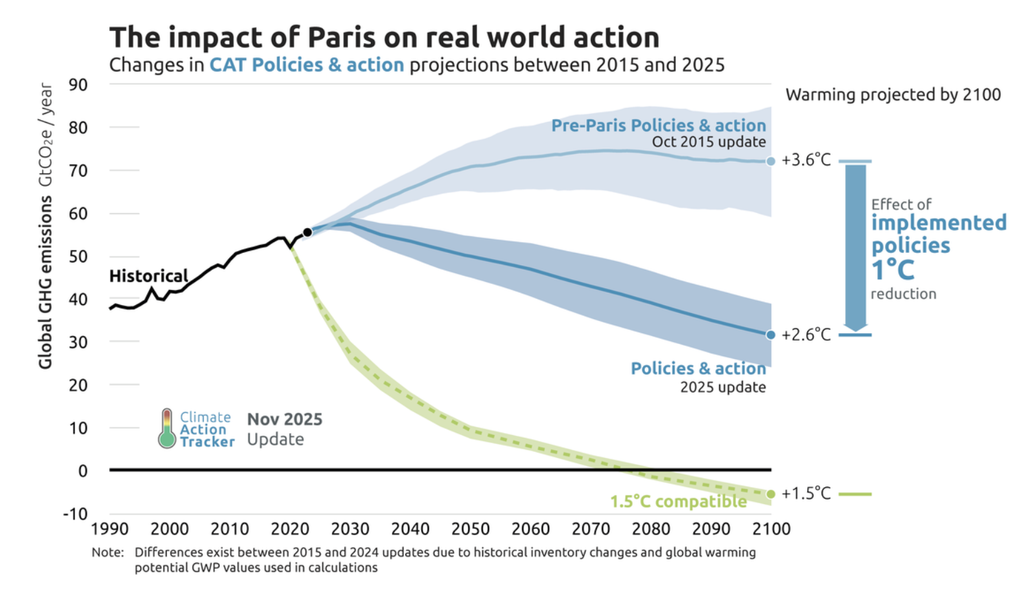
The independent Climate Action Tracker (CAT) shows that while the world is still not on target to meet the ambition of the Paris Agreement, the cumulative effect of the pledges and targets inspired by the Agreement has reduced the projected temperature in 2100 by 1.3°C.
Updated policies and actions have driven projected warming by 2100 down from 3.6°C in 2012, to 2.6°C in 2026 (see Figure 1). However, CAT also reports that ambition has stalled, and collective efforts must grow.
Figure 1
Retiring RCP8.5 rules out a pathway to severe climate impacts, but not the destination
While reaching RCP8.5 and SSP5-8.5 levels of emissions is now implausible, the warming levels and climate impacts associated with this pathway cannot be ruled out.
Warming may still be higher than anticipated, even if emissions are lower
It is still possible that global temperature rise will reach levels of warming consistent with the RCP8.5 and SSP5-8.5 scenarios, even if emissions are lower. Carbon emissions from human activity are just one of the parameters used in climate models to determine those levels; the sensitivity of the Earth’s climate system also matters. If the climate system is more sensitive to emissions, lower emissions could still lead to greater warming.
Various feedback loops in the climate cycle can amplify warming. For example, declining natural carbon sinks impact how much of the carbon we emit stays in the atmosphere rather than being absorbed by plants, and melting snow and ice reduce the reflectivity of the Earth’s surface and add to warming.
The April 2026 announcement from ScenarioMIP makes no claims about those factors, or about the ongoing plausibility of the consequences to people and planet that were associated with RCP8.5. It addresses the plausibility of the GHG emissions trajectories, rather than the warming outcomes and associated impacts of those trajectories. Yet these broader questions are central to the next stage of the research effort from the climate science community.
Lower emissions do not rule out fast-onset irreversible climate change
The Earth system is complex and relies on a delicate balance, which makes it hard to predict exact outcomes. Even small disruptions can push critical systems past their ‘tipping points’, triggering large-scale and irreversible changes, even at low emissions levels.
These changes can occur suddenly after a threshold has been crossed. For example, the transformation of the Amazon rainforest region into a dry savanna is a fast-onset tipping point, whereby changes could occur in a matter of decades once the tipping point is crossed.
The crossing of tipping points is no longer a future risk; it is already happening. A first tipping point – the widespread dieback of warm water coral reefs – is already underway, with tangible impacts for the hundreds of millions of people who depend on these ecosystems.
Given the persistent uncertainty around how feedback cycles and tipping points behave at high warming levels, RCP8.5 and SSP5-8.5 remain a useful reference point – even though the emissions pathway itself is no longer considered plausible.
Risks associated with warming are greater than previously thought
As their understanding has improved, scientists have found that many climate change risks are greater than previously thought. While climate policy over recent years means we may see less warming than previously predicted, the consequences of lower levels of warming now appear to be worse than previously believed.
The latest IPCC report, published in 2023, found that the risks now associated with 3°C of warming are greater than those it had predicted in 2014 for 5°C, and much greater than those predicted in 2001 for 6°C.
This is because the definition of climate risk – which refers to the intersection of hazards, exposure and vulnerability – was expanded to be more comprehensive, including additional social aspects such as justice and equity.
Current climate policies and actions put us on track for about 2.6°C warming by 2100. This poses a world in which billions of people are affected by dangerous heat and water stress, and food shortages and ecosystem degradation are commonplace (see Table 1).
Table 1
In 2026, we are experiencing a world that is about 1.4°C hotter on average than in the pre-industrial era, before humans started burning coal and other fossil fuels in large quantities, and we are seeing dangerous consequences as a result.
Uneven warming means some regions are already experiencing over 2°C of warming as their new baseline temperature (see Figure 2). Countries that experience higher-than-average levels of warming – such as Europe and the Arctic region – may be pushed into extreme warming levels in line with those projected by RCP8.5 and SSP5-8.5.
Figure 2
During extreme events, localised temperatures can be pushed up significantly higher. For example, in the UK, the number of days 10°C above the average quadrupled in 2015-2024 compared to 1961-1990.
During the April 2026 heatwave, official reports showed maximum temperatures generally 3°C to 6°C above normal across major cities, with markedly higher departures – locally approaching 7°C to 8°C – over northern India, Nepal, Pakistan and the Himalayas. Temperatures as high as 47.6°C were recorded, and 43.9 million people were exposed to the most extreme heat conditions, intensified by climate change, during this single heat wave alone.
Low-emissions pathways are also no longer feasible – our options for combatting climate change are narrowing with every year of unchecked emissions
RCP8.5 and SSP5-8.5 are not the only climate pathways under scrutiny. As GHG emissions keep rising every year, our best-case low-emissions scenarios, which would have seen warming limited to 1.5°C, have also become inconsistent with observed emissions trends.
When surveyed in 2021, only 4% of scientists working on the previous IPCC assessment report (AR6) predicted that global warming would be limited to 1.5°C by the end of the century. Every scenario in the IEA’s latest World Energy Outlook shows the world surpassing 1.5°C.
What ‘limiting warming to 1.5°C by the end of the century’ now means is that we will overshoot that temperature temporarily before bringing temperatures back down again. According to Keywan Riahi, the Energy, Climate, and Environment Program Director for the International Institute for Applied Systems Analysis (IIASA),
The loss of both our ‘best-case’ and ‘worst-case’ scenarios means we’re walking an ever-narrowing path. With every year that emissions aren’t meaningfully cut back, we are reducing the options available to us to tackle the climate crisis. This is particularly concerning as many of the cheapest mitigation options become less available the hotter temperatures get, which could lock us into higher levels of warming.
Climate scientists are now engaged in a vital and urgent effort to understand how the decisions made in the next few decades will shape the possible futures available to humanity. As emissions change in the coming years, scientists will continue re-calculating which scenarios are most feasible.
At the same time, they are seeking to further their knowledge of how our rapidly changing planet can make projected warming even worse, thanks to unpredictable changes to a previously stable climate system.
The knowledge and tools needed to move us towards better case scenarios already exist
In recent years, as the feasibility of 1.5°C came under increasing threat due to inadequate emissions cuts, scientists began the work of trying to understand what this would mean and what our next best-case, Paris Agreement-aligned scenarios would be.
Even if ‘best-case’ scenarios are becoming less likely, we still have opportunities to keep warming down to levels that are less harmful – as far below 2°C as possible. Analysis by the Potsdam Institute for Climate Impact Research (PIK) and Climate Analytics shows that a scenario in which “countries finally live up to that ‘highest possible ambition (HPA)’ promise” could see warming fall to roughly 1.2°C by 2100, after peaking at around 1.7°C before 2050.
In this scenario, global CO2 emissions reach net zero before 2050 and global GHG emissions reach net zero in the 2060s. We already know how to achieve this outcome, and have most of the tools available to do so:
- Rapid electrification of power, transport and much of industry, so that by 2050, nearly two-thirds of energy demand needs are met with clean electricity.
- Rapid and immediate phase out of fossil fuels, so that advanced economies are fossil-free by 2050, and the global economy is fossil-free by 2070.
- Sharp fall in methane emissions, so that by 2030 methane emissions have decreased overall by 20%, and by 50% in the energy sector, relative to 2020 levels.
- Scale up of carbon removal, to bring temperatures down from peak levels and reduce the duration of the 1.5°C overshoot. Even if carbon removal is rolled out at only half the speed assumed, the world could still get back to below 1.5°C, provided emissions are cut fast. However, a greater magnitude and duration of overshoot comes with added risks and uncertainties.
